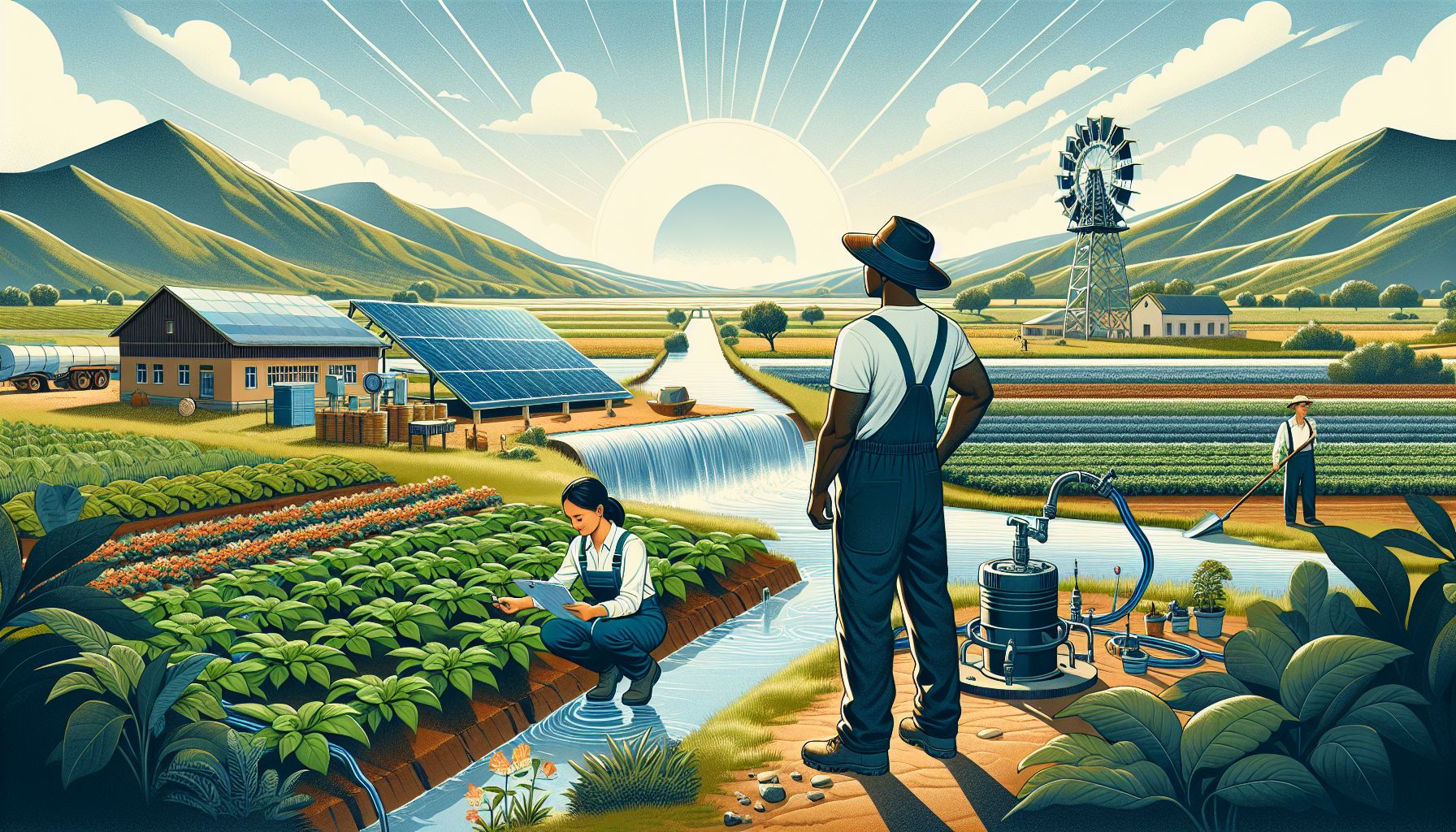
In the face of a changing climate and increasing global populations, the demand for food and water resources is rapidly rising. Worldwide, agriculture is by far the largest consumer of freshwater, accounting for about 70% of total freshwater withdrawals globally (FAO, 2020). As these pressures mount, it has become crucial that we start rethinking our intervention strategies to achieve sustainable water management in agriculture.
The Challenge Ahead
The challenge before us is significant yet straightforward- How to do more with less? Farmers need to produce more food, feed, and fibre to feed a growing population, while at the same time reducing their water footprint and ensuring that the use of water resources is sustainable in the long run.
This challenge becomes even more complex when we consider that water use in agriculture does not only lead to depletion of freshwater resources, but also to several environmental problems, such as eutrophication and salinization of soils, which can have detrimental effects on biodiversity and human health (OECD, 2017).
In this context, sustainable water management in agriculture can be defined as the use and treatment of water in a way that does not compromise the water needs of future generations, the environment, or human health.
Steps towards Sustainable Water Management
Achieving sustainable water management in agriculture is no easy task, but it can be facilitated through a combination of practical strategies, technological advances, and policy interventions.
-
Water-Efficient Irrigation Methods: Several water-efficient irrigation techniques can be used to reduce water waste. These include micro-irrigation techniques such as drip or trickle irrigation, which deliver water directly to the plant roots, thereby avoiding evaporation losses. However, these techniques need to be carefully managed to avoid over-irrigation and leaching of nutrients.
-
Rainwater Harvesting: Rainwater harvesting is a simple, low-cost way to capture and store rainwater for future use. It can reduce the reliance on groundwater for irrigation and can be particularly useful in regions with seasonal rainfall patterns.
-
Soil Conservation Techniques: Healthy soils have a greater ability to retain moisture, reducing the need for irrigation. Techniques such as cover cropping and conservation tillage can help enhance soil health and water-holding capacity.
-
Precision Agriculture: Precision agriculture uses high-tech tools and data analysis to optimize crop production. By monitoring soil moisture levels and crop needs in real time, farmers can adjust their watering schedule to avoid over-irrigation.
-
Use of Drought-Resistant Crop Varieties: Breeding and genetic engineering can be used to develop crop varieties that are more efficient in their water use or more tolerant to drought conditions.
-
Policy Reform: Appropriate water pricing, water rights allocations, and regulations on pollution can incentivize sustainable water use and discourage wasteful and polluting practices (World Bank, 2017).
In conclusion, sustainable water management is crucial for the future of agriculture. To ensure a water-secure future for all, it is necessary to broaden our approach even further. Partnerships among farmers, businesses, governments, and scientists are essential to drive innovation and ensure the widespread adoption of sustainable water practices.
As Benjamin Franklin once wisely said, “When the well is dry, we know the worth of water.” By managing water resources more sustainively, we can ensure that future generations do not have to learn the worth of water the hard way.